
Bamboo as a Construction material can be used for scaffolding, bridges, houses, and buildings. Bamboo, like wood, is a natural composite material with a high strength-to-weight ratio useful for structures. Bamboo has an extremely robust structure that makes it a great building material. Bamboo has a tensile strength that is comparable to steel and a compressive strength that is two times greater than concrete. Shear stress in bamboo fiber is higher than in wood. Unlike wood, bamboo has a wider spread.
Additionally, bamboo may be bent without breaking. In comparison to steel, which has a tensile strength of 23,000 N per square inch, bamboo is regarded as one of the building materials that are exceptionally strong. Due to its low cost and environmentally friendly attributes, bamboo is strongly appreciated for use in contemporary construction. Bamboo has advantages over conventional building materials, such as lower carbon dioxide emissions. Bamboo may trap carbon dioxide at a faster rate than conifer or hardwood forests, according to tests done in China. As a result, growing bamboo for construction purposes has environmental benefits in addition to those provided by its substitution for cement and steel. Since bamboo deflects more due to its low density, it is much preferred as reinforcement in members taking less-loaded constructions like public restrooms, parking lots, and sunshades. Despite this, bamboo has tensile properties that are approximately identical to steel-reinforced concrete.
Due to its flexibility, strength, and tube-like shape, bamboo is an excellent disaster- and weather-resistant construction material. It is also light and convenient to move from one location to another. Compared to trees, it emits 35% more oxygen and absorbs 40% more carbon dioxide. Bamboo is common in many places and may even grow up to over a meter in a day, so there is no need to worry about it being extinct. As proof, a group of bamboo houses withstood three typhoons that slammed the Cook Islands and all 20 bamboo houses in the epicenter of a 7.5 magnitude earthquake in Costa Rica.
- Due to bamboo’s high strength-to-weight ratio, structures made of it are subjected to less force during earthquakes and are less likely to collapse, endangering fewer people.
- By virtue of its tensile strength, bamboo is flexible and resistant to lateral shocks from earthquakes.
- Each of the main components of bamboo has a different density, which affects the frequency at which they want to vibrate. These two frequencies cancel each other out when vibrations pass through the bamboo, causing the stem to remain stable.
- Bamboo has a high fire tolerance and can withstand temperatures of up to 4000 C. This is due to the high concentration of silicate acid and water.
- Due to its elastic qualities, bamboo is widely favored in earthquake-prone areas.
- Bamboo can be paired with other materials such as mud, vegetable materials, and other daubs, to increase the structure’s capacity for absorbing energy.
- Nails, typical carpentry fasteners, and rope can be used in bamboo joinery systems to distribute forces and absorb shocks during earthquakes, allowing the various components of the structure to move as one unit.
- Bamboo provides a sustainable and renewable construction solution.
- Bаmbоо іѕ 100% biodegradable.
- Cost Effective and Easy to Cultivate.
- Elasticity, Bamboo Bends rather than Breaking.

Bamboo as a building material has high compressive strength and low weight and has been one of the most used building materials as support for concrete, especially in those locations where it is found in abundance. Bamboo as a construction material is used for the construction of scaffolding, bridges and structures, and houses. Bamboo has been used as a building material for centuries due to its strength, flexibility, and sustainability. It is widely available in many parts of the world and offers an alternative to traditional construction materials like wood or concrete. Here are some common bamboo construction techniques. Bamboo Framing: Bamboo can be used as a structural element in building frames. It can be split into thin strips, called splints, which are then tied or lashed together to form columns, beams, and trusses. Bamboo frames can be used for various types of structures, including houses, bridges, and pavilions.
Apart from its limited use as furniture and sheds, the construction industry expects bamboo as a construction material has become a more common material in the construction of buildings and complexes. Bamboo has a bright future owing to its sustainable and environmentally friendly characteristics, as well as the incorporation of new technologies and prefabrication methods.
- Bamboo Reinforcement: Bamboo can be used as reinforcement in concrete structures. Bamboo strips or rods are inserted into the Bamboo Matting: Bamboo mats are created by weaving together strips of bamboo. These mats can be used as wall panels, flooring, or roofing materials. Bamboo mats provide insulation and can be used as a substitute for conventional materials like plywood or drywall.
- concrete to enhance its tensile strength. This technique is particularly useful in earthquake-prone areas where the flexibility of bamboo can help withstand seismic forces.
- Bamboo Plywood: Bamboo plywood is made by gluing together multiple layers of bamboo strips, creating a strong and durable material. It can be used for wall paneling, flooring, furniture, and other interior applications. Bamboo plywood is an eco-friendly alternative to traditional plywood made from hardwood trees.
- Bamboo Joinery: Bamboo can be joined together using various techniques such as lashing, doweling, or using bamboo nails. These joinery methods allow for the construction of sturdy and stable structures without the need for metal fasteners or adhesives.
- Bamboo Thatching: Bamboo can be used for roofing by laying bamboo stalks side by side and securing them to a frame. This technique is commonly used in tropical regions and provides good ventilation while protecting against rain and sun.
- Bamboo Composite Materials: Bamboo fibers can be combined with resin or other binders to create composite materials. These materials can be molded into various shapes and used for construction purposes, such as wall panels, furniture, or decorative elements.
It’s important to note that the specific techniques used in bamboo construction may vary depending on the region and cultural traditions. Additionally, proper treatment and maintenance of bamboo are crucial to ensure its longevity and resistance to pests and decay.
Due to a distinctive rhizome-dependent system, bamboos are one of the fastest-growing plants in the world and their growth is three times faster than most other species of plants. They are renewable and extremely versatile resources with multi-purpose usage. Among many uses of bamboo, Housing is one of the major area applications, especially in the wake of residential shortages around the globe. Bamboo as a building material is conventionally associated with the region of Southeast Asia and South America where the climate is best suitable for its cultivation. In many nations, bamboo is used to hold up suspension bridges or simply make places of dwelling.
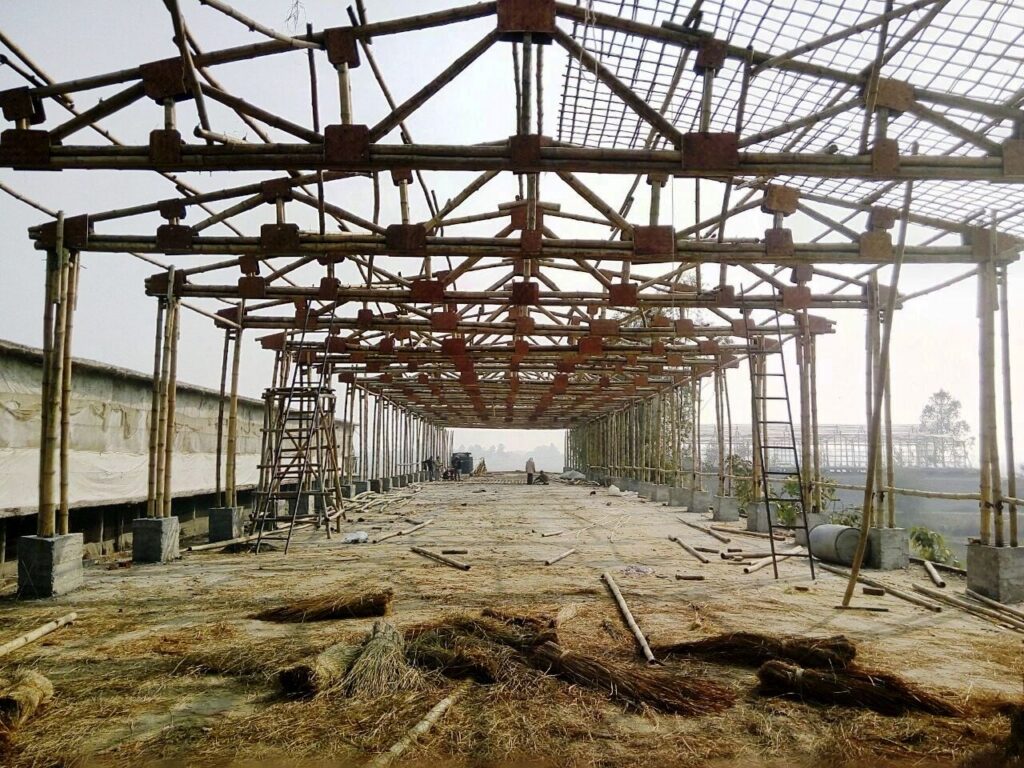
Various Structural Shapes of Bamboo as a Building Material
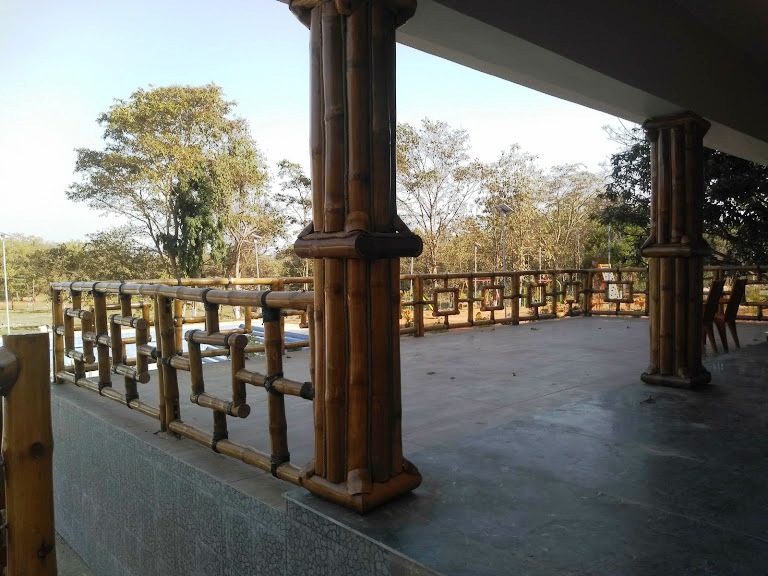
Bamboos are treated in such a way that they assume desired shapes and structures while they grow:
- A squared cross-section can be obtained by compressing the growing stalk of bamboo within a square section.
- Arch shapes of bamboo can also be created by compressing the bamboo’s growth into the desired shape. This would cost lesser than it would to get the same form with normal timber.
- Curved and Flat shapes of bamboo are achieved through traditional techniques like applying heat and pressure.
Methods of Working on Bamboo
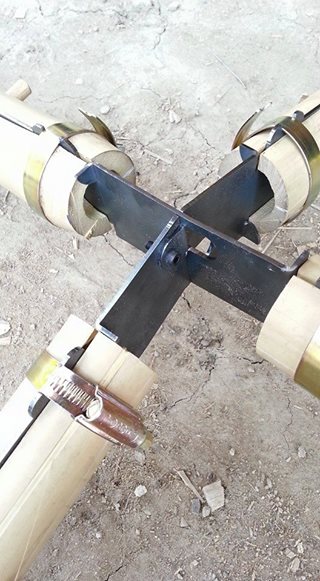
For bamboo to be used as a building material, it must be worked on to create desired shape, bend and length to be used for structural or other purposes. Following are the different works involved with use of bamboo:
- Splitting
- Shaping
- Bending
Splitting of Bamboo
The bamboo canes are split into halves or quarter sections using a knife ideal for the job and setting them apart by a wedge. About four or eight segments can be acquired which are used as canes, strips or battens. Canes can be peeled to make strings and ropes up to the age of 18 months.
Shaping of Bamboo
Even though bamboos are naturally circular in form but if they are grown in a box of square shape they acquire a shape as desired.
Bending of Bamboo
Bamboos can be bent while they are freshly cut by heating them above the temperature of 150° C. Bamboo will retain this shape even after cooling and drying off.
Preservation of Bamboo
A thorough treatment of Bamboo is required to protect it against insects and rot before it is put into use. Commonly a mixture of Borax and Boric acid are utilized for this purpose. Another procedure generally employed is to boil cut bamboo to remove the starches that draw insects.
Bamboo as a Building Material
Utilization of Bamboo for construction is achieved by a structural frame technique which is related to the same approach applied in usual timber frame design and construction. In the case of bamboo, the floor, walls, and roof are interconnected and often rely on the other for overall stability. Bamboo has played a vital role in the growth of enterprises and rural transformation.
Bamboo for Foundations
There is very limited use of bamboo as foundation material because when in contact with moisture laden surface they decay fast. However, this issue can be tackled to quite an extent through proper treatment using appropriate chemicals. The various types of foundations constructed with bamboo are: a) Bamboo which is in direct contact with ground surface. b) Bamboo fixed to rock or preformed concrete footings c) Composite bamboo or concrete columns d) Bamboo